LTUE 2014 report

Not that many of you care, but I spent three days last week in the Life, the Universe, and Everything Symposium on Science Fiction and Fantasy in Provo, Utah. Short version: I had a great time. There most of you can go now.

Long version for everyone else: Dang I’m tired!

One of the main change-ups from last year for me was my involvement with the crew from The Authors’ Think Tank, a blog and podcast for writers by writers. Last year I met Melva Gifford, the Grand Dame of LTUE, who suggested I get involved in the local writing community and gave me a few places to check out. So I did, and found The Authors’ Think Tank, a growing community of writers online, and began writing guest posts for their blog. It’s grown to a regular, weekly post, but in all this time I’ve never met anyone from the “staff.”

That changed at LTUE this year. They also do a weekly podcast, and needed help recording more material. Since there are a lot of writers to be found at LTUE they decided to see how many they could line up. Final total: 24. That number is telling. For James Duckett, who recorded and hosted pretty much every one of them, I’m sure it felt like one of Jack Bauer’s bad days. I got involved as often as I could and was there for maybe a third of them. We had some awesome guests, and I got to meet most all of the Think Tank crew. Great people! I had a blast.

Some things I learned from the podcasts? For one, Brandon Sanderson is one busy guy. He was generous enough to give us half an hour when he should have been writing his remarks as Toastmaster for the final Grand Banquet. He had the flushed, haggard look of someone who is busting his butt trying to make as many people happy as possible. I’m afraid my compliments on “The Rithmatist” came across more fanboy-ish than I intended, but he took it well. I’m sure he’s used to being Brandon Sanderson, even though that’s probably not always fun.

I also had a somewhat less embarrassing encounter with L. E. Modesitt, Jr. Before we began recording, as he was getting settled he seemed to be staring just a little bit at me and/or my name tag. I thought maybe it was because I hadn’t introduced myself. I told him I had just finished reading one of his books the previous week and I was looking forward to his being on the podcast. He replied that he’d read my review. To paraphrase Meg Ryan in “Joe Versus the Volcano”, I had no response to that. It later occurred to me that I’d mentioned the book to make a point in my Think Tank blog post the day before, which was also the day my own review of the book came out. Chances are he saw the Think Tank post, perhaps if he visited the site to find out just who it was planning to interview him. Still…

It was also interesting to see that some people we interviewed found us a little intimidating–or at least the high-quality microphone we had staring them in the face. Also, most writers do not look like their author’s photo. They look…well, normal. Even Mercedes M. Yardley was not at all what I would have expected for a horror writer. With her red bandana headscarf and soft, pleasant voice she had more of a Red Riding Hood vibe.

I’m pleased to say that every podcast I sat in on seemed to go well. Guests who might have begun a little tentatively soon warmed up, and it seemed as though they had as much fun doing it as we did. I don’t think anyone was scarred for life, anyway.

Also fun was getting to see friends I made last year. Practically right off the bat the first morning I encountered Michaelbrent Collings. He remembered me (I don’t even think my name badge was showing at the time!), and even remembered my hair was longer than last year. (I’ve been growing it out a bit at my wife’s request, and to see if I could achieve an “artist look”.) Michaelbrent was a Special Guest this year, a distinction well earned because, well, he’s awesome incarnate. He’s entertaining, full of interesting stories and experiences, is able to teach the craft, and recognizes he’s there for the attendees.

I also visited here and there with Dave Butler, aka D. J. Butler, author of the only Mormon Steampunk novel I’m aware of. He’s also a good guy, and a Treasure Valley transplant like me. We lived within ten miles of one another in Boise, and now live within forty miles of each other in Utah. We’ve also traded comments back and forth on Facebook over the past year, so it wasn’t as surprising he remembered me. He also introduced me to the Wests (Brook and his wife), who are nice people with delightful period/steampunk costumes. I also met many other great people, but my apologies if I don’t name you all here.

My attendance in sessions dropped off considerably over the three days, as did my note-taking. I went to nearly all the sessions on Thursday, about half on Friday, and actually made it to a few on Saturday. Part of this was due to the aforementioned podcasting, so certainly no regrets there, but also partly due to the new Kaffeeklatch sessions they introduced this year where you can sign up for a smaller, informal session with a brave writer who entertains you and your questions for 50 minutes. But I also ran out of steam as the week went on.

Saturday I took my daughter and two of her friends down with me. They, being card-carrying students, could get in for free. I kept an eye on them, but they’re old enough to hold their own. I’m happy to report, however, that they gave out before I did. Okay, not my daughter. She would have been good for another couple of hours, probably. She’s already practically begging me to let her skip school next year so she can go for more than one day.

Next year I may try and change things up a bit. I’d like to start making it more about networking and getting to know more people. I’m going to start working on building my “street cred” and see about getting on some panels. And perhaps most of all, I want to start working on becoming more like a Melva Gifford or Michaelbrent Collings (and Michael, his dad, for that matter) and see if I can do more giving while I’m there, not just taking.

At the very least I’m determined there will be a ‘next year’.

Posted in Random Musings | 2 Comments

Men and romance

I was over on James Duckett’s blog this morning reading about a discussion he had with a fellow writer and decided to comment. A blog post later I realized I’d written a blog post. I’m reposting this here, because…well, I put in a lot of work, doggone it!

Anyway, James begins thusly:

While at LTUE today, Wendy Knight had asked this interesting question:

I’m in this panel right now, and they’re saying that men want romance just as much as women, but they show that in different ways. I don’t think I agree…or else wouldn’t boys read romance novels? Thoughts? Opinions?

I replied something akin to, “It’s true, we like it. We don’t read romance novels because they aren’t written for guys, they are written for girls. Since we are wired differently, we need it presented differently.”

She seemed… somewhat convinced, but it got me thinking about it. Yes, I do like romances. Some of my most favorite movies are “Dan In Real Life” and “The Wedding Singer.” All of these have the basic romantic formula (boy meets girl, boy likes girl, boy loses girl, and they get together). So why does this work and not a Harlequin Romance or something like “Steel Magnolias”?

He goes on to examine several movies he feels are good examples of “romance for guys.” At that point I noted some excellent examples on his list, and some omissions. So I added my two-thousand cents:

Yes, guys want romance. At least some guys. Not all women want romance either, at least not the Harlequin Romance variety. Guys just need to connect with it our way. We want it in ways where the men can still be manly. Roman Holiday, Philadelphia Story, African Queen, Casablanca, Adam’s Rib….these are all romances, and they totally rock! Or, to get more modern, your list here does nicely.

I’ve not seen all of them, but Dan in Real Life is SO spot on! I felt Dan’s anguish every step of the way. What guy can’t relate to finding the perfect woman only to find out she “belongs” to someone else who doesn’t appreciate or deserve her? Rick Springfield wrote “Jessie’s Girl” for us, girls, not you! But Dan is damaged goods, and he needs to fix himself–not for her, but for himself–before he can be happy.

You’ve Got Mail is one I would add to the list. Besides being the story of my wife’s and my romance, it fits. Tom Hanks’ character, despite being different from his dad and grandfather, is still more like them than he realizes, and therefore has trouble finding the “right” relationship. He has relationships not for deep connections, but for convenience and, I believe, appearances. He has a girlfriend, but he’s about the only one who can’t see she’s wrong for him (Parker Posey plays her mercilessly unsympathetic). He hangs around with a jaded, snarky crowd, and has learned to act that way, but inside he’s much better than that.

And he’s in an email-only relationship with a woman he’s never met. She connects with that guy inside who he would rather be, but can’t. If he could ever meet her you just know she would set him free. We just know it! So it’s not coincidence that he’s the first to find out who “she” is–and she’s the enemy, the book shop owner who his latest mega-store is  driving out of business, and she’s publicly raking him over the coals! And she’s in a relationship, too (also a real head-scratcher, but at least Greg Kinnear’s character is charming, if clueless.).

Hanks’ Joe Fox has to change, too, but again it’s not for her. He already suspects, because of their email connection, if he could learn to let the real him be seen she would love him. But he has to first learn that it’s okay to let someone into his life–his real life–and to be in love for love, not convenience. And he also has to convince Meg Ryan that he really can be that guy she’s in love with via email, not the horrible public personae she believes him to be.

It’s also a fascinating study in denouement. Once they finally come together in real life the movie ends RIGHT THERE. In a way I’d love to see them together more,but for a movie it’s actually perfect. We already know they’re perfect together–we’ve seen it in every email exchange, and during Joe’s “tweaking” experiment. In this regard Nora Ephron gets it right in a way she didn’t in Sleepless in Seattle. We SUSPECT they are right for each other in that one, but we’re not really given a chance to see it. We know they’re not right for anyone else in the movie, but other than the whole “destiny” thing, how can we really be sure?

As an aside, While You Were Sleeping is another good one. Yes, it’s about Sandra Bullock’s character, but Bill Pullman’s character is such a great, relatable, good-guy I found myself cheering for him to get her as much the women viewers were cheering for her to wake up and fall in love with him.

So yes, there are guys who like romance. We just want it differently. The Harlequin Romance formula doesn’t work for us, and we don’t care much for the whole “bad-boy-changes-for-good-girl” thing, but we can still “get” romance.

Posted in Random Musings | 7 Comments

My novel, it is borken

I went to LTUE and found out my novel is broken. In the second panel I attended, discussing outlining and pre-writing, it dawned on me. I outlined my novel to death. But what killed it exactly? Here’s the list that occurred to me:

  • In mapping out my sub-plots I became confused as to which was the main plot.
  • I didn’t really think through what I thought was the main plot. After nearly a year it has occurred to me that it’s a really dumb way of choosing a country’s leader. Watery tarts in ponds distributing weaponry would be a better idea than what I had.
  • My outline was too detailed. I think I may have become bored writing the novel because I instinctively felt I had already written it.
  • I let a concept lock me into going a particular direction when it was not necessary.
  • I had too many subplots, and too much happening “off screen”.
  • I avoided conflict when I should have been focusing in on it.

So, what do I plan to do about it? Well, unfortunately the damage is done, and changing all the elements I believe need to be changed makes much of what I have already written obsolete. I believe it’s time to plug all the world-building holes I’ve identified and start over again. And it will be much better for it, I’m certain.

It goes against everything I’ve been told, but I really think it would be a waste of time to press forward and finish at this point. Yes, I’d gain the confidence of knowing I finished. But knowing it’s so broken would make it take for ever to finish. It would be better if I started over, as I’d be more excited and more motivated. I’m pretty sure I’ve identified the problems, and that I have a good idea as to how to fix them. I only wish It wouldn’t have taken me so long to figure it out.

But had it not been for LTUE I might still be beating my head against the tree, trying to chop it down.

Posted in Writing | 13 Comments

Recognizing the good

In case you haven’t noticed, I do a lot of griping about the bad behavior I see online. And yet, in so doing I perpetuate the problem. The jerks are by no means the majority, but it’s easier for them to evoke an emotional response from me than it is for the good people. I really ought to stop focusing my attention in that direction. There is good to be found, and I need to spend more time acknowledging it.

Last year around this time I went to LTUE, a three-day writing conference. Along the way I was referred to the The Authors’ Think Tank, an online community started by Jennifer J. Bennett, a mom and writer from Saint George, Utah. With the help of several others she created a blog, started a weekly podcast, built a Facebook community, and recruited help to generate content. Not long after I found the site Jennifer put out the call for volunteers to write blog posts. Still flushed with the excitement of LTUE, I volunteered, even though I don’t consider myself all that knowledgeable. I certainly don’t have much in the way of references. But I figured I could at least write about the beginner writer’s experience and offer some encouragement.

Jennifer accepted my offer, and I began to produce a post or two every month for awhile. Last fall she came to me again to see if I’d be willing to commit to a regular spot. I agreed to try once every two weeks.

Well, late last year Jennifer had to make a tough call. She couldn’t keep up with everything she has to do and turned responsibility for the site and community over to some of the others. James became the new rallying point, and in the process of offering him what support I could I suddenly found myself agreeing to a weekly post. I also found myself invited into the “Inner Circle”, though I’ll admit I’m not entirely comfortable there yet. I’m hoping to fix that some at this year’s LTUE.

The point of this, though, is that Jennifer, and now James, recognized the need for a community for writers of all levels, and that’s what they built. My experiences have been quite positive, and though it’s grown to the point that I can’t keep track of all the activity on the site and the Facebook community, I can see what they’ve accomplished is quite unique. I’ve come to know several of the regulars some, and know where I can turn for help should the need arise. I see others using the community for all kinds of feedback and assistance, which is precisely what it was intended for.

So I’m calling out Jennifer and James, and the rest of the crew for recognition as an example of “The Good To Be Found Online.” Way to go, guys!

Posted in Gratitude | 7 Comments

Gone learnin’

It’s that time of year again. “Life, the Universe, and Everything” begins in Provo today. I’ll be there, taking two days off from work so that I can subject myself to three days of panels, presentations, and speeches around the art of writing.  (By the way, why do we shorten it to LTUE, and not LTUAE?)

I’m excited, even though I remember just how grueling those three days can be. They pack the day with classes, often as many as eight different events at a time, and they don’t let up, not even for lunch. As much as I would have liked to attend a class every hour, I had to skip some here and there last year just to recharge. But that’s okay, because there’s plenty going on outside of the formal sessions, as well. For example, last year I got to meet the fascinating and genial Michaelbrent Collings by hanging out in the vendors area for awhile. I also got to chat with D. J. Butler, author of the “Rock Band Fights Evil” series and a new series of LDS Steampunk. Both were very encouraging, and darned decent fellows.

This year I’ll be taking on an additional challenge. On Saturday I’ll be bringing not only my daughter (I’m too mean of a dad to let her take any days off from school), but two of her friends also. Actually it shouldn’t be that bad. They’re old enough to not need my supervision, and they’ll probably be hanging out together, which will help me worry even less. I was concerned about how Emma would do in some of the workshops by herself last year, but I needn’t have been. She’s got enough guts to ask questions in front of hundreds of adults, and the presenters took her seriously. Not that they shouldn’t have–she asked questions as intelligent as many the adults asked. But it’s always nice when people treat your kid well. I think they saw an opportunity to encourage the next generation.

Last year was my first year. This year I’ll hopefully be able to relax a bit more. I’ll be a little less obsessive about making sure I get to every class I’m interested in. Hopefully I’ll be a little less fan-boy-ish when I encounter people I admire (although Orson Scott Card will be there this year, so if I get the chance to meet him, all bets are off–if there is one writer I can assign credit for my being a writer it’s probably him). And I’ve seen on this year’s schedule that a number of classes are repeats. If I keep going every year there’ll eventually be less new classes to take in.

But mainly I’ll purposely try to take it easier this year. I need to pace myself. It’s not like I won’t get my money’s worth. At work I’ve (or rather my company has) paid $1200 for a twelve-hour class. Here I’ll get as much as 33 hours of instruction for $45. And my daughter gets in free. Seriously, that’s a fantastic deal. Salt Lake City Comicon is $60 for three days, and won’t be nearly so educational (not that it’s intended to be).

So yeah, I’m excited. Not as excited as my daughter, but only because I’m too old and tired to be that excited. The little kid in me is getting the giggles.


Posted in Random Musings | Comments Off on Gone learnin’

Book Review: Imager, by L.E. Modesitt, Jr.

Every now and then a book hits all the right notes with me. “Imager”, book one of the “Imager Portfolio” by L.E. Modesitt, Jr., is one such book. It’s a fantasy novel set in an unfamiliar world with a Victorian era technology level reminiscent of Florentine Italy. Modesitt mixes the familiar with the unfamiliar in interesting ways to create a world we can grow quickly familiar with, and yet still recognize as different.

But that’s not the main strength of the novel. Modesitt really thinks things through. His magic system, while perhaps not developed to the level of detail that Brandon Sanderson goes to on how it works, makes sense within the scope of the world. Imagers, people with the ability to picture something in their mind and have it become reality, make sense within the larger context of the world. Some cultures fear and despise them, killing or imprisoning anyone who shows the ability. Some consider them heretics. In the country of Solidar, where the story takes place, they walk a very fine line in which they must continually prove their worth the ruling council and the public at large to avoid the purges that so many other countries experience. They voluntarily become public servants in order to avoid drawing the ire of that public. Even so, they are feared and unwelcome in many places.

Our hero Rhennthyl is the oldest son of a succesful merchant/industrialist, but has no interest in the family business. Instead he becomes an apprentice portraiturist. But this is all turned upside down when he discovers he is also an imager. Much of the book deals with his training at the collegium for imagers, and so echoes similar stories like “Harry Potter” and “The Name of the Wind”, and yet is different enough that you won’t notice. For one thing, Rhennthyl is an adult when he enters the collegium, but he’s not the smartest knife in the drawer. He is pretty darn good, but he makes mistakes–errors consistent with his character.

Modesitt weaves an interesting story–interesting enough that you hardly notice there’s not a real strong plot, at least not at first. Discovering the world and how it works is more than enough to keep one’s attention. And when the plot begins to form it turns out to be something significantly less than earth-shattering. And that’s okay. This book is a fine example of the idea that the scope of the plot need not be earth-shattering to make us care. The stakes can be small and personal, and if we care about the character we’ll care about the plot. Such is the case here. We like Rhennthyl. We want him to finally succeed at something and be compensated for everything he’s put up with.

Modesitt knows how to tell a story, and it’s a story that can be appreciated by most any age group. There are adult elements, but not to excess.

I’m eager to get my hands on the next book in the series and see what happens next for Rhennthyl and his family. I have other books ahead of it in line, but you can bet it’ll be there.

Posted in Reviews | Comments Off on Book Review: Imager, by L.E. Modesitt, Jr.

The Green Chapel, Part Two

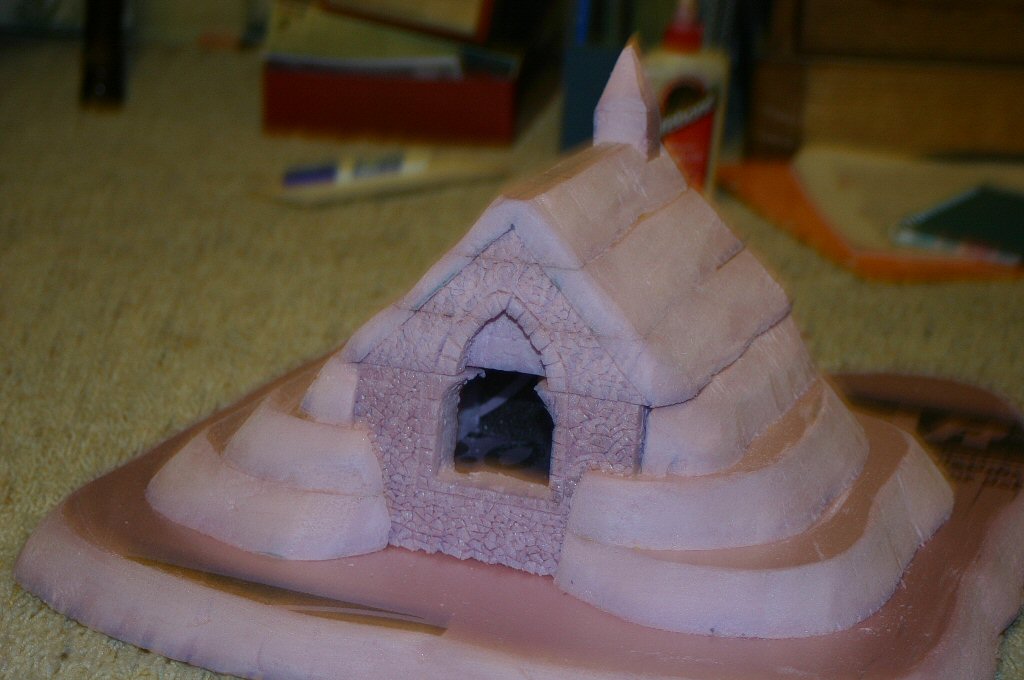
I’ve been making some slow progress on my Green Chapel terrain piece for Warhammer. Part One can be found here, if you like. But as a reminder, here’s what it looked like at the end of the “roughing out” phase:

The Green Chapel, structure complete and awaiting painting and detailing.

The Green Chapel, structure complete and awaiting painting and detailing.

The next step was to prepare it for painting. To do this I had to take some watered-down Elmer’s glue (or reasonable substitute) and paint over every surface. This is to keep the chemicals in the spray paint from reacting with the Styrofoam and melting it. However, this also helps my regular paints to stick, the coating on the foam tends to resist liquids. I changed my mind on the spray paint, but I’m glad I took the glue-coat step anyway.

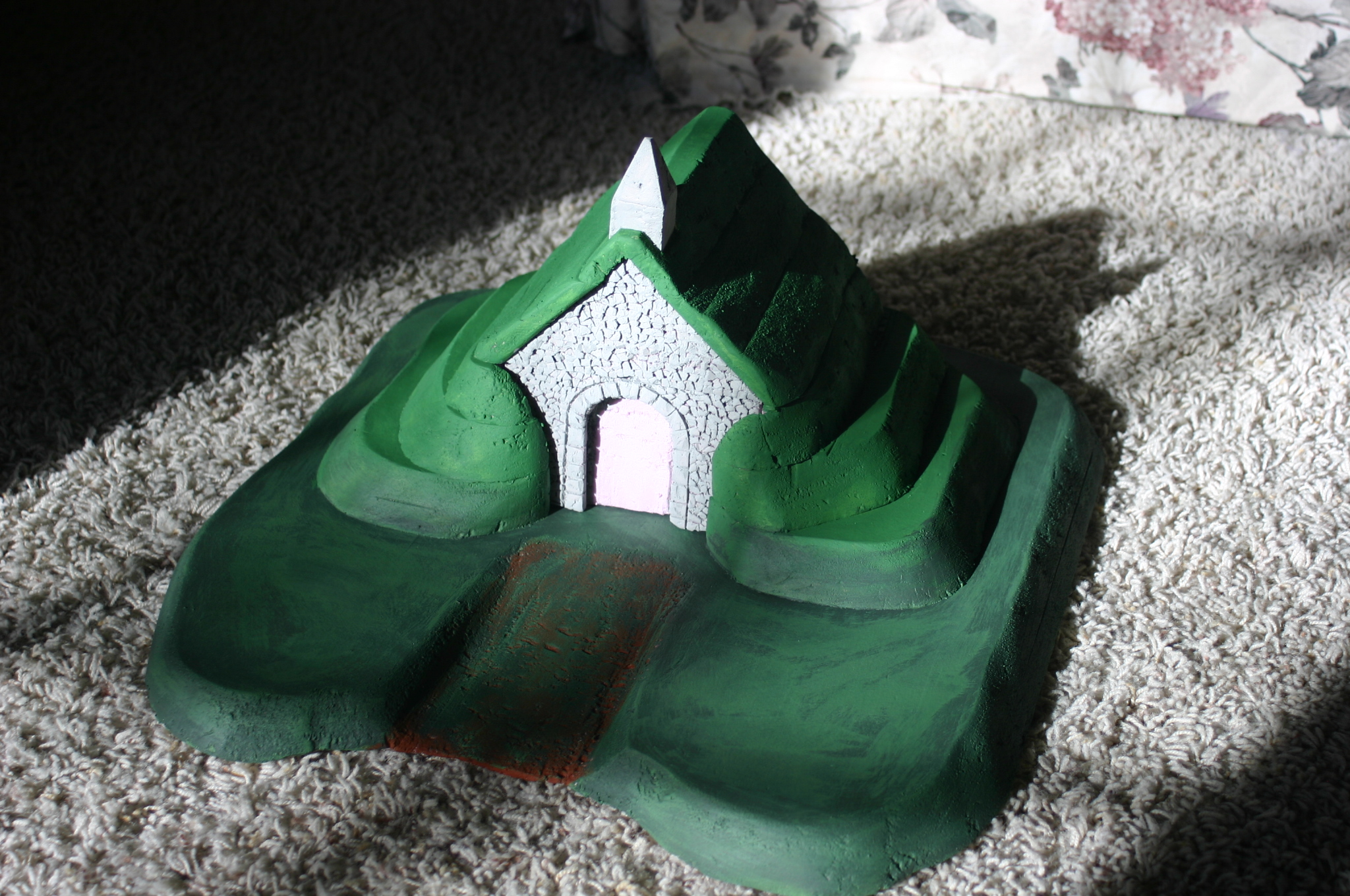
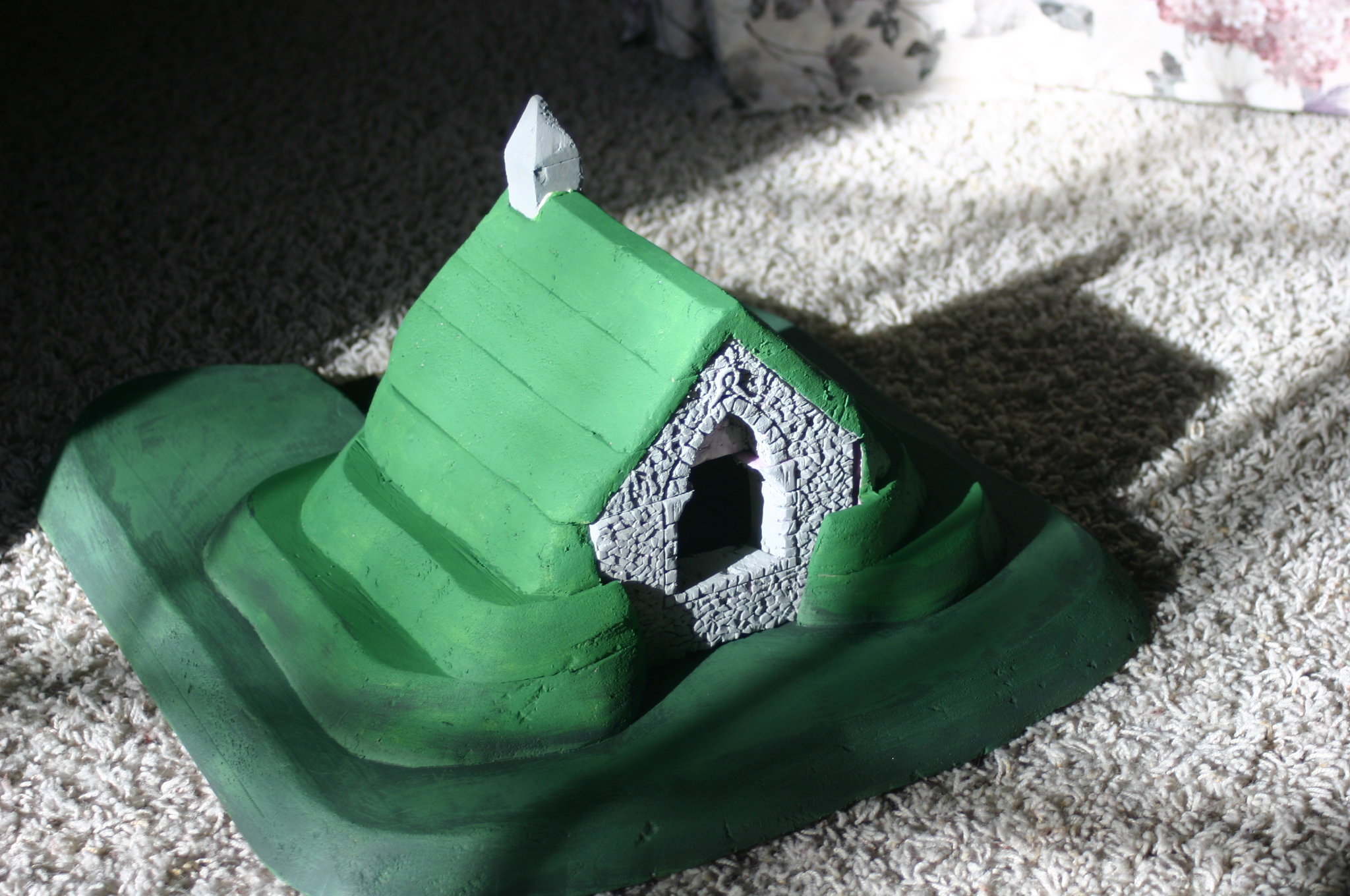
Now that it was ready to paint I went at it. The stone front and back I painted in a basic gray. The base and sod sides and roof I used at least three different shades of green to tried to blend them to look as natural as possible. Here’s how the chapel looks after two coats:

The Green Chapel, post-painting, from the front.

The Green Chapel, post-painting, from the front.

The Green Chapel, from the back.

The Green Chapel, from the back.

It’s now essentially ready for detailing, and I’m considering flocking all the green areas for good measure. However, before I get any farther on the paint, I need a front door and a stained-glass window. I’m still trying to find the right material for the front door, but my kids bought something this weekend that came in clear plastic packaging that provided enough material for a window insert.

In hindsight I would probably not take this approach again, but since I want to be able to have miniatures inside the building if necessary, I made it so the top comes off. This, however, also means my window is divided into two parts. My stained glass inserts also need to come in two parts, and they don’t really match up as well as I’d like. The other problem is that the top section is solid foam. I cut a recessed area for the window, but it ends not even an inch deep. This doesn’t help the top part of the window blend well with the bottom part because the lighting is different through each. You’ll see what I mean in a minute.

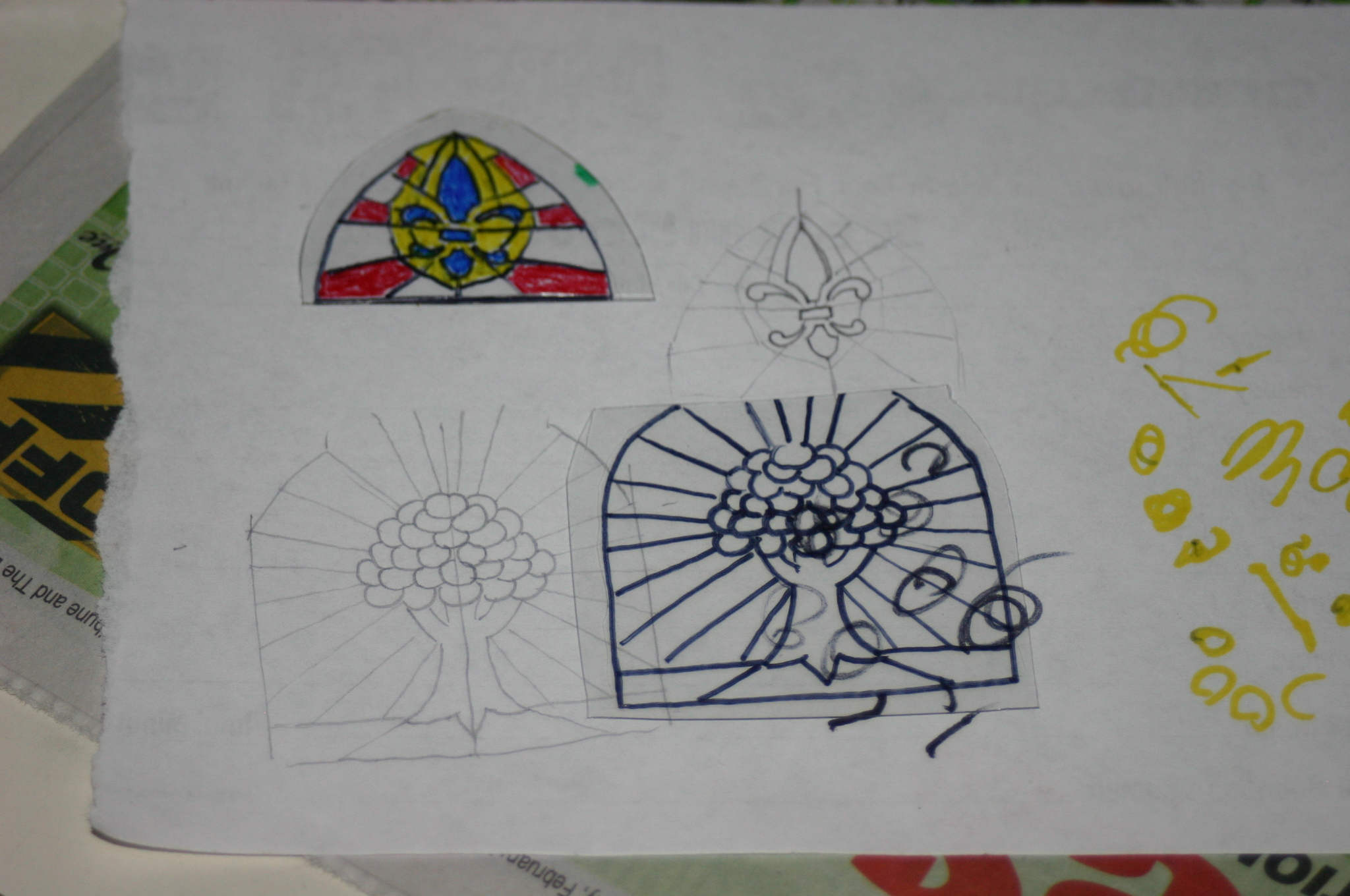
Designing the window was also trickier than I imagined. We have a set of Sharpie pens I figured I would use. I should probably have gotten pens with even finer points, but the ones I had were okay. First I had to sketch out the design. Then I would take my plastic window piece and lay it over the top and trace with black Sharpie for the frames. Then, after it had a chance to dry, I’d flip it over and color in each pane on the back.

Stained-glass windows in progress.

Stained-glass windows in progress.

I didn’t quite get the effect I was hoping for. The Sharpie doesn’t color opaque enough on that plastic. Next time I’ll either find a slightly less clear plastic or find a way to frost it a bit first. Still, I can’t complain too badly for a first attempt, and with my somewhat lacking artistic skills. It turned out okay.

The Green Chapel, complete with window.

The Green Chapel, complete with window.

So now we’re still looking for door material. I have a few ideas, but I need to take the time to look and see what I have to work with, or invest in some thin balsa sheets. Once I get the door in place I will go over the “stone work” with a dark wash, then vary the shade on individual stones a bit to make it a bit more natural. Then I’ll dry brush with a lighter color to bring out the 3D effect. Then, after perhaps a layer of green flock, I’ll probably experiment with making trees and put a tree or two in the “front yard”, and perhaps a bush or two around the edges, perhaps even on the roof. If I’m feeling especially daring I may try to paint some ivy on the stone areas as well.

I’ll keep you posted.

Posted in Random Musings | 2 Comments

The Great Debate

Warning: This post contains religion. If you find this offensive please skip this post.

What did the Bill Nye/Ken Ham debate really accomplish? The topic itself was entirely beside the point, ultimately. My love of God or acceptance of Christ as savior really has nothing to do with how old the earth is. Had Genesis said that “In the first immeasurable period of time, God started the natural processes in motion, resulting in the earth” I’d be no more or less strong in my faith.

Instead this debate did little but further highlight the false dichotomy of science and religion. Allowing Ken Ham to speak for Christianity is allowing people to think that he represents a lack of diversity of Christian belief. And there is great diversity in Christian belief. There are scientists out there for whom there is no dichotomy.

“This was not productive or beneficial to science education — it was a spectacle, pure and simple,” said Matthew Bonnan, a paleontologist at the Richard Stockton College of New Jersey who blogs at The Evolving Paleontologist.

“There is a fear among many Americans that if they accept science, and evolution in particular, they have to abandon their faith,” Bonnan said. “But science and faith are different things, which are not diametrically opposed to each other.”

I’ve not seen the debate, and I’ve caught only snippets of what was supposedly said. But supposedly Bill Nye, when asked what it would take for him to change his belief, gave a list of natural laws he felt he would have to see violated in order to believe in creationism and, by extension, God. While I can understand why he might take that view, it’s not necessarily an imaginative one. He is assuming that God must work through means contrary to nature, that to prove his existence God has to leave fingerprints of impossibility on everything he creates.

But what if God works through natural means? What if there is no evidence of God because everything is evidence of God? Why would a natural system that makes sense be any more difficult for a god than a system that is inconsistent and capricious? Or what if there is no scientific evidence of God because God, for his own reasons, is not interested in settling the matter beyond dispute?

In my own religious views, that is indeed the case. I have no doubt that if God wanted the matter settled he could settle it. And I believe that one day he will. But until then God purposely does not reveal himself irrefutably, and for one simple reason: he loves us. Contrary to the image some religions have of God, he did not create all of this and all of us so he can have a bunch of angels sitting around singing his praises. That would be like me building an entire house from scratch so that I could make a place for a bunch of bacteria whose soul purpose is to tell me how good looking I am.

No, God has a much better plan for us than that. If all he wants is sycophants, why send us to earth in the first place? Just keep us around as angels and have us do the angel-choir thing all the time. What we’re here for is to further our growth as beings, and to prove ourselves worthy for even greater growth. But there is one down side to that plan: in order for us to be able to choose to prove ourselves, there has to be the option to not prove ourselves.

Going against the will of God is what is usually called sin, and if we were to come to earth as mortal beings we would sooner or later go against God’s will. Even if God were fully visible and known to us all we would sooner or later succumb to the weaknesses of mortality. And in that state there is no way we could ever redeem ourselves once we messed up the first time.

But as I said, God loves us. He set up the test so that mercy is also possible, not justice only. God keeps his distance during the test so that faith enters the picture. For those who have faith enough to seek him out, God is there. But I believe that the room for doubt he built into the test is at least partly what opens the way for repentance and forgiveness. Coupled with Christ’s mission to ransom us, we are able to change and become more what God wants us to be.

So in short, God has not settled the issue of his existence beyond any doubt for our own benefit. He is not interested in dooming us with a perfect knowledge in an all-too-human body. By leaving room for doubt, there becomes room for forgivable error.

I know some people will view this as a cop-out. That’s fine. I could say the same about their beliefs, if I cared to. While my beliefs make perfect sense to me I don’t expect everyone else to think the same way I do. On the other hand, others shouldn’t expect me to think the way they do, either. Just because they’ve convinced themselves there is no god doesn’t mean I have to agree. I don’t. I believe in God. And ironically, both Bill Nye and Ken Ham would probably disagree with me. But then that’s okay, too. I think their debate was rather pointless, and discussed matters largely irrelevant to the question. But it was their choice.

Ain’t freedom of thought wonderful?

Posted in Random Musings | 1 Comment

Cayce Pollard Units

I think there’s a little Walter Mitty in me. Maybe there is in everyone. I don’t know. Your results may vary. But I do sometimes find myself daydreaming or wishing that somehow my life were a little larger than it is. Not necessarily a lot larger, mind you. I don’t know that I’d want to be The Person on whom the fate of the Free World hinges or anything like that. Just perhaps that my life were a bit more cool. Where is my Hubertus Bigend to tempt me with the money to pursue my goals so long as I share the results with him?

It’s great for a novel, but that sort of thing just doesn’t happen. And I can’t convince myself to borrow coolness by imitating a novel, either. Yeah, it would be fun to spend a little money and create my own male versions of Cayce Pollard Units to wear. Others have, it seems. It even appears that someone has created a line of clothing inspired by William Gibson novels. But I don’t get into that, as much as it may tempt me. Is it simply because I can’t justify spending the money? Is it a desire to keep my geekiness in the closet, figuratively rather than literally? Or is there some subconscious independent streak that refuses to let me get that deeply into someone else’s world, or believes that the life of the mind should stay there? I don’t even get into Star Wars or Star Trek cosplay. Do I feel a need to enjoy things but keep some distance?

I have no answers for that. I do have a long cape. But capes are generic. I wore one for a role in “Mystery of Edwin Drood” in college and really liked it. I also liked the cassock they dressed me in, too, but I never got one for myself. My mom made the cape for me. Perhaps I should have asked for the cassock. It’d be all the rage now, with that Severus Snape verve.

I keep telling myself that if I ever become a successful author I’m going to commission some custom clothing to wear to signings and conferences or conventions. But will I really? I suppose I might if it’s not too obvious. Perhaps a Prada Steampunk knockoff, if I can find a talented-enough tailor. More likely I won’t. I’ll probably opt for just looking like me.

I imagine it’d be more important how I behave than how I look. I want to be one of those cool authors who makes you feel better about yourself for having spoken with them. I’m not that person now, so I guess I’d better get to work on that and worry less about what I would like to wear should my life ever become larger than it is.

Posted in Random Musings | 2 Comments

Book Review: The New School, by Glenn Harlan Reynolds

Most people who know Glenn Reynolds know him as Instapundit, a blogger known more for his pithy asides about articles he links to, not necessarily his own opinions on the topics he covers. Some may even know him for his wife, Dr. Helen Smith. But in spite of the fact that Mr. Reynolds must spend 80% of his day just reading other people’s blogs and news sites, he has also put together the research for a book, “The New School: How the Information Age Will Save American Education From Itself” (oddly enough, the guy known for blog posts consisting of a linked “Heh” writes terribly long titles).

In this book Reynolds takes on our current education system. He begins with some history, tracing the sources of the system we currently have back to its roots. Then he takes a serious look at what is going wrong with our university system today. It’s not a pleasant view. College costs are soaring, while the value of college degrees are decreasing. More and more graduates can’t find work. Administrative costs are rising rapidly, while colleges are turning more and more to part-time adjuncts to teach the students.

Reynolds declares our current situation a “Higher Education Bubble”, and shows that it can’t last. Indeed, there are already signs that it may be about to burst.

What’s more, K-12 education doesn’t look much better. Reynolds looks at a variety of causes for why our primary education system is feeding poor students into the secondary education cash machine. The reasons are not what you might think, and Reynolds’ observations are not going to make him many friends in the educational establishment. Yet Reynolds, a Law professor at the University of Tennessee, is a part of that “establishment”, and has as much to lose as anyone when the bubble bursts.

The book also digs into what other options there may be for either reforming an ailing educational system or replacing it with something better. There is hope out there, but the next ten years are going to be difficult, even a little frightening, as we are forced to deal with wholesale change. Just like the current workforce had to adjust to the demise of the “one-company career”, we may be forced to accept the loss of the “high-school, college, and a job” paradigm before long.

The New School is a reasonably short read. He doesn’t belabor his points and tries to keep the subject matter interesting while sufficiently bolstering his arguments. In the end he’s guessing as much as anyone about what is going to happen, and he admits it. But he has been paying closer attention than most of us, so I’m willing to bet his guesses are better than most. In any case, the real message is clear, and it’s not a happy one: change is coming. If something is too good to last, it won’t.

This book is worth reading, even if it’s not a feel-good read. Being caught off guard will be even less pretty.

Posted in Reviews | Comments Off on Book Review: The New School, by Glenn Harlan Reynolds